

You have a part design in hand — a cup, a tray, a lid, or a custom enclosure. The material is selected. The next question is often the one that stalls the project: which forming process will actually deliver the geometry, surface quality, and production volume you need? This guide breaks down the real differences between pressure forming and vacuum forming in terms of what matters at the production floor: achievable detail, dimensional consistency, cycle behavior, and material compatibility. By the end, you will have a clear framework for matching the process to your part — not the other way around.
The Core Difference — Force, Not Just Technique
Both processes begin identically: a thermoplastic sheet is heated until it becomes pliable, then drawn into or over a mold. The divergence happens in how the sheet is pushed against the mold surface.
Vacuum forming relies on removing the air between the heated sheet and the mold, allowing atmospheric pressure — a maximum of 14.7 psi at sea level — to push the sheet into contact. This is the simpler, more established method, and it remains the workhorse for many disposable packaging products.
Pressure forming combines vacuum with positive air pressure applied from above the sheet. That pressure — commonly in the range of 60 psi or higher, roughly four to five times the force of vacuum alone — actively forces the material into fine mold details, tight radii, and textured surfaces.
The practical implication: vacuum forming pulls the sheet toward the mold; pressure forming drives it there. That distinction determines everything downstream — from whether your part’s logo will be legible to whether the bottom corners of a deep cup will hold their thickness.
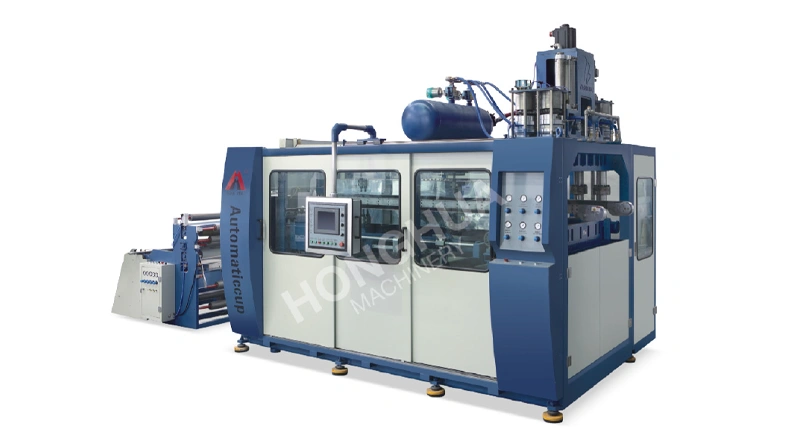
If you are evaluating how this force difference translates into specific machine capabilities, the forming technology section on our thermoforming equipment overview page outlines how pressure and vacuum systems are configured on production equipment.
Where the Difference Shows Up — A Decision Framework
The table below summarizes the factors that most directly affect part quality and production economics. Use it as a starting point for your own part evaluation.
| Decision Factor | Vacuum Forming | Pressure Forming |
| Achievable detail | Moderate — suits simple geometries, generous radii | High — reproduces fine texture, sharp corners, embossed features |
| Dimensional tolerance | ±0.8mm per 300mm (typical) | ±0.5mm per 300mm (typical) |
| Deep draw capability | Limited — wall thinning at depth | Good to excellent — more uniform wall distribution |
| Cycle time | Shorter — simpler force application | Longer per cycle — pressure application and release add time |
| Tooling complexity | Lower — simpler mold construction | Higher — mold must withstand pressure and often includes pressure boxes |
| Typical products | Trays, plates, shallow lids, simple packaging | Cups, bowls, medical trays, textured enclosures, precision packaging |
How to read this table for your part:
If your product is a shallow tray or a simple plate, vacuum forming will typically produce it faster and at lower tooling cost. If your product is a deep cup with a smooth rim and consistent wall thickness, or a lid with a snap-fit feature and a logo that must be crisp, pressure forming is the process that will meet the specification without constant production troubleshooting.
One more consideration that rarely appears in basic comparisons: material behavior under pressure. A study published in Thieme Connect on thermoplastic retainer materials found that pressure forming applies “a substantially larger and more uniform compressive load against the surface during cooling than vacuum forming,” which promotes near-surface densification of the polymer as it solidifies. In production terms, this translates to a more stable part that is less prone to post-forming warpage — particularly relevant for thin-wall packaging where dimensional stability affects stacking and sealing.
Reading Your Part Drawing — What to Look For Before Choosing
Before committing to a process, examine your part design against these four questions. Each one points toward one process or the other.
1. What is the depth-to-opening ratio?
A part with a depth greater than its opening diameter (a deep cup, for example) will stretch the sheet significantly. Vacuum forming alone struggles to maintain uniform wall thickness at ratios above roughly 1:1. Pressure forming, especially with plug assist, manages deeper draws by pre-stretching the material mechanically before applying air pressure.
2. Does the part have sharp internal corners or fine surface texture?
A radius under 1mm, an embossed logo, or a matte/grained finish will not reproduce reliably under vacuum alone. The atmospheric pressure differential is simply insufficient to push the sheet into small features. Pressure forming’s higher force is what makes those details possible.
3. What tolerance can your downstream process accept?
If the part must fit into an automated filling, sealing, or capping line, tolerance matters. The difference between ±0.8mm and ±0.5mm per 300mm may be the difference between a lid that seals reliably and one that leaks intermittently. If your specification references a tight tolerance, pressure forming is the process that can hold it.
4. What is the production volume, and how sensitive is the unit cost?
Vacuum forming’s simpler tooling and shorter cycle times translate to lower per-part cost at high volumes. Pressure forming’s tooling is more expensive, and cycles are longer, but the process can produce parts that would otherwise require injection molding or secondary assembly. The calculus changes when the part complexity is high enough that vacuum forming would generate unacceptable scrap rates.
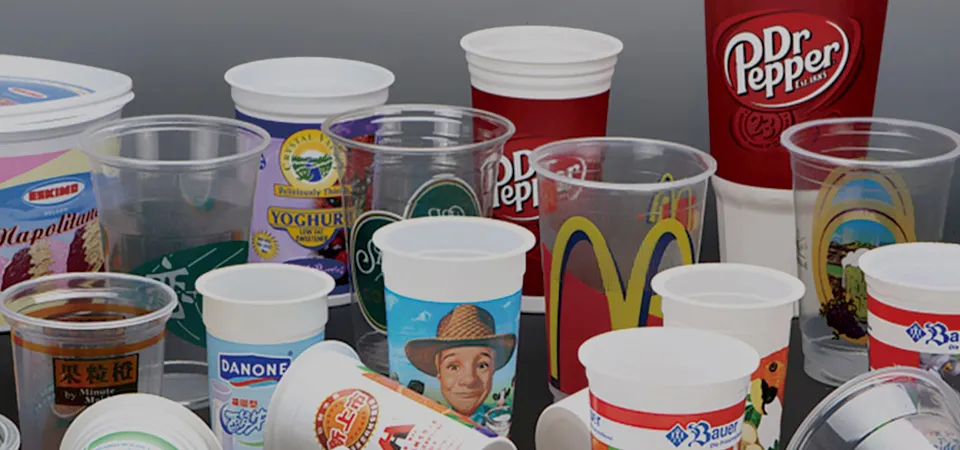
For product-specific forming considerations — how cup geometry, for instance, interacts with pressure forming parameters — the application details on our plastic cup production page provide a useful reference.
Real Production Scenarios — Where the Choice Becomes Clear
Scenario A: High-volume disposable cups for a beverage brand
The part is a 500ml PP cup with a rolled rim and a smooth interior. Volume target: 800,000 cups per day. Wall thickness must be consistent enough for reliable stacking and leak-free lid application.
In this scenario, pressure forming with plug assist is the standard approach. The plug pre-stretches the sheet, and pressure forming ensures the rim forms cleanly and the sidewall maintains thickness from rim to base. Vacuum forming would produce cups with thin bases and inconsistent rims at this depth — unacceptable for a product that must seal.
Scenario B: Shallow trays for bakery packaging
The part is a 180 × 120mm PET tray, 25mm deep, with a simple rectangular geometry and no fine surface detail. Volume: 200,000 per day.
Here, vacuum forming is the more economical choice. The shallow draw does not challenge vacuum pressure, the geometry is simple, and the shorter cycle time translates directly to lower unit cost. Investing in pressure forming tooling for this part would add cost without improving the product in any way the customer would notice.
Scenario C: Medical device enclosure with a textured surface and tight tolerances
The part requires a matte finish that must survive sterilization, and it must fit into an assembly fixture with ±0.3mm clearance.
Pressure forming is effectively mandatory in this case. The texture will not reproduce under vacuum, and the tolerance target is beyond vacuum forming’s typical capability. The higher tooling investment is justified by the fact that no alternative thermoforming process will meet the specification.
For industries where these production scenarios play out — food packaging, medical trays, industrial enclosures — the precision plastic thermoforming solutions how material selection and forming technology are matched to application requirements.
Next Step: From Process Understanding to Equipment Matching
You now have a process-level understanding of when pressure forming delivers value and when vacuum forming is the more efficient path. The next step in a real procurement cycle is translating that understanding into machine specifications: what forming area, what pressure capability, what heating configuration, and what automation level will your part and volume require?
That specification conversation is different from a product brochure comparison. It requires working backward from your part drawing, your material, and your target output. The thermoforming machine selection guide on our technical content library walks through that backward calculation in detail — forming area from mold dimensions, depth from part geometry, and cycle speed from daily output targets.
Once you have those numbers, comparing specific machine configurations becomes a grounded engineering exercise rather than a feature-list comparison.
Related Reading
-
How to Choose a Plastic Thermoforming Machine: Complete Buyer's Guide
-
Understanding Forming Depth and Stretch Ratio in Thermoforming
-
Material Selection for Thermoforming: PP, PET, PS, and PLA Compared
-
From Sheet to Finished Product: How an Integrated Thermoforming Line Works
-
Common Thermoforming Defects and How Process Parameters Prevent Them