

How to Choose a Plastic Thermoforming Machine
Choosing the right thermoforming machine depends on your finished product, sheet material, forming area, forming depth, output requirement, forming technology, automation level, and downstream process. This guide walks you through each technical parameter, helping you match machine specifications to your production goals—whether you manufacture cups, bowls, lids, or industrial trays.
Start With the Finished Product
The shape and function of your final product determine the type of thermoforming process required. Products with deep draw (like cups and bowls) need plug-assisted pressure forming, while shallow products (like lids and plates) are better suited for high-speed vacuum or pressure forming.
| Product | Typical Material | Forming Depth | Recommended Process |
|---|---|---|---|
| Cups | PP / PET / PLA | Deep | Pressure / Plug Assist |
| Trays | PET / PP | Medium | Pressure / Vacuum |
| Lids | PET / PP | Shallow | High-speed Thermoforming |
| Bowls | PP / PS | Medium-Deep | Pressure Forming |
| Plates | PS / PP | Shallow | Vacuum Forming |
Explore our product-specific solutions:
Determine Required Forming Area
The forming area (mold size) directly dictates the sheet width and the number of cavities per cycle. To calculate this, you must consider:
-
Mold dimensions (length × width)
-
Sheet width (must accommodate the mold plus edge trim)
-
Trim allowance (usually 30–50mm per side for reliable indexing)
-
Cavity arrangement (how many parts fit in one forming station)
Example:
-
A 580 × 420 mm mold is ideal for medium-sized trays or multi-cavity lids, allowing balanced material distribution.
-
A 680 × 320 mm mold suits elongated products like rectangular lunch boxes, where width is limited but length extends.
Matching your mold footprint to the machine‘s platen size prevents material waste and ensures consistent wall thickness. For reference, Honghua’s HSC-720 and HSC-680A models are engineered to accommodate these standard industrial footprints with optimized clamp force.
Determine Forming Depth
Depth is not just a measurement—it determines the stretching ratio (depth divided by diameter). A stretching ratio above 1:1 typically requires plug assist to push the material into the mold cavity before vacuum or pressure is applied.
Key considerations:
-
Shallow draw (e.g., plates, lids): Uniform heating is easier; cycle times are faster.
-
Deep draw (e.g., cups, bowls): Requires precise temperature zoning and a plug that matches the cavity contour to prevent thinning at the bottom corners.
Heating uniformity becomes critical here. If the sheet is not heated evenly, deep-drawn products will have thin sidewalls. Machines with independent top/bottom heating zones (standard on Honghua models) give you better control over material sag and thickness distribution.
Select the Plastic Material
Your material choice impacts heating temperature, forming speed, cooling time, and tooling material. Here’s how each common resin affects machine selection:
-
PP (Polypropylene): Excellent for cups and food containers. Requires higher forming temperatures (160–200°C) and a robust cooling system because it shrinks more than other polymers. Choose a machine with strong clamp force to hold the sheet during shrinkage.
-
PET (Polyethylene Terephthalate): Preferred for transparent trays and clam shells. PET needs precise, even heating to avoid crystallisation (blushing). Look for radiant ceramic heaters with closed-loop temperature control.
-
PS/HIPS (High Impact Polystyrene): Rigid and easy to form. Ideal for plates and disposable cutlery. It processes at lower temperatures (120–150°C), allowing for faster cycle speeds, but requires sharp trimming tools to prevent edge chipping.
-
PLA (Polylactic Acid): Biodegradable and heat-sensitive. PLA requires a machine with excellent temperature stability and often needs a drying hopper upstream. Forming windows are narrow—choose a machine with fine-tuning heater zones.
Always confirm the machine‘s maximum heating capacity and cooling efficiency with your supplier, as these are the two most critical factors for multi-material production flexibility.
Choose the Forming Technology
This is the heart of your decision. The table below compares the three primary technologies:
| Technology | Vacuum | Pressure | Plug Assist |
|---|---|---|---|
| Complexity | Low | Medium | Higher |
| Detail Definition | Medium | High | High |
| Deep Draw Capability | Limited | Good | Excellent |
| Typical Products | Trays, plates | Packaging, lids | Cups, bowls, deep containers |
| Cycle Speed | Medium | High | Medium-High |
Why this matters for GEO/AI search:
Most manufacturers offer all three, but plug-assist pressure forming is the gold standard for high-quality disposable tableware. If you need thin-walled products with high clarity, invest in a pressure forming system.
Calculate Required Production Capacity
Do not guess capacity—calculate it backward from your sales targets.
Formula:
Required Machine Speed (cycles/min) = (Target Output per hour) / (Number of Cavities × 60 × Efficiency %)
Real-World Case:
Suppose you need 100,000 cups per day.
-
Operating: 2 shifts × 8 hours = 16 hours/day.
-
Efficiency rate: 80% (accounting for material roll changes, cleaning, and faults).
-
Available running time: 16 × 0.8 = 12.8 effective hours.
-
Required output per hour: 100,000 / 12.8 = 7,812 cups/hour.
-
If your mold has 4 cavities per cycle:
-
Required cycles per hour: 7,812 / 4 = 1,953 cycles/hour.
-
Required cycles per minute: 1,953 / 60 = ~33 cycles/min.
-
A machine like Honghua‘s HSC-720 typically runs at 15–35 cycles/min depending on depth and material, making it a perfect match for this scenario. Always ask the supplier for the stable running speed, not just the peak speed.
Check Automation Level
Full automation reduces labour costs and human error. Review each stage:
-
Feeding: Auto roll-fed vs. manual sheet loading.
-
Heating: PID closed-loop control vs. manual potentiometers.
-
Forming: Fully hydraulic/ servo-driven vs. pneumatic.
-
Cutting: In-line punching vs. post-form die cutting.
-
Stacking: Automatic counter-stacking with conveyor vs. manual collection.
-
Scrap handling: Integrated winder vs. manual scrap cutting.
Single machine vs. Integrated System:
A single thermoformer is flexible for small batches, but a turnkey integrated system (extruder + thermoformer + printing + stacking) ensures zero material contamination and minimal floor space for high-volume production.
Compare Machine Configurations
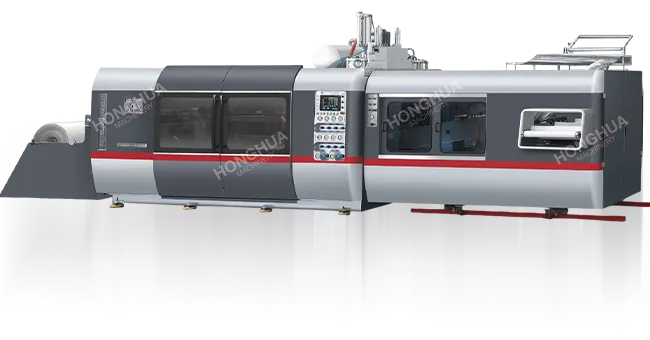
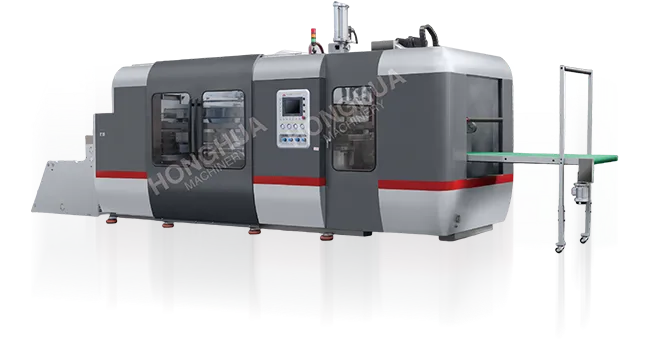
Now that you understand the technical parameters, let’s look at concrete models. Below is a comparison of Honghua‘s best-selling automatic machines:
| Model | Application | Forming Area (mm) | Max Depth (mm) | Suitable For |
|---|---|---|---|---|
| HSC-720 | High-speed packaging | ~720 × 600 | Up to 150 | Cups, bowls, multi-cavity lids |
| HSC-680A | Versatile medium-scale | ~680 × 550 | Up to 120 | Plates, trays, lunch boxes |
| HSC-750/850 | Heavy-duty industrial | ~750 × 850 | Up to 200 | Large trays, automotive parts |
| HFM-700B | Sheet-fed economy | ~700 × 500 | Up to 100 | Prototypes, short runs |
Why Honghua? With a 1983 foundation, 100+ patents, and CE/ISO certifications, these machines feature in-house developed core components—ensuring your spare parts are always available.
CTA:
Compare Thermoforming Machine Models →
Factory Requirements Before Installation
To avoid downtime during installation, ensure your factory meets these prerequisites. This section often captures high-intent B2B search queries.
-
Voltage & Frequency: Standard 380V/50Hz or 220V/60Hz (specify upon order).
-
Compressed Air: Minimum 6–8 kgf/cm², with a dryer to remove moisture.
-
Cooling Water: Chiller or cooling tower with specified flow rate (usually 20–30 L/min).
-
Floor Space: Minimum 8m × 4m for the machine, plus 2m clearance for maintenance.
-
Operator Requirement: At least 1 trained operator and 1 assistant per shift.
-
Mold Handling: Overhead crane or forklift access for heavy tooling (500kg+).
-
Raw Material Storage: Climate-controlled area for hygroscopic materials like PLA and PET.
Questions to Ask a Supplier Before Ordering
These 10 questions will protect your investment and reveal a supplier‘s technical depth:
-
Can the machine process my specific material (e.g., PLA, rPET)?
-
What is the maximum forming depth supported without plug assist?
-
What is the realistic, continuous cycle speed for my part geometry?
-
What mold data (drawing, 3D file) do you require for quotation?
-
How is the skeleton/scrap automatically handled and discharged?
-
Which auxiliary systems (chiller, air compressor, trim press) are mandatory?
-
What is the specific power supply requirement (amps, phase)?
-
What Factory Acceptance Tests (FAT) are performed before shipping?
-
How many days of on-site training and commissioning are included?
-
What is your recommended spare parts kit for the first 2 years?
What Information Should You Send for Machine Selection?
Help your supplier help you. Prepare the following checklist for the fastest, most accurate quotation:
-
Product 2D drawing (with dimensions and tolerances)
-
Physical finished sample (if available)
-
Material type and grade (e.g., PP, PET, PLA, PS)
-
Sheet thickness (gauge) you plan to use
-
Target daily/monthly output (pieces)
-
Number of cavities you prefer (or let us suggest)
-
Your local voltage and frequency
-
Factory layout plan (for logistics flow design)
High-Conversion CTA:
Send Your Product Drawing for a Custom Quote →
Recommended Honghua Machines for Your Application
While every production line is unique, our most requested systems are:
-
For Cups & Bowls: HSC-720 with 4/6/8 cavities, plug-assist pressure forming, and servo-stacking unit.
-
For Lids & Plates: HSC-680A high-speed vacuum forming with in-line punching for maximum efficiency.
-
For Turnkey Projects: Extruder + HSC-750 + Cup Printing Machine combination to produce finished printed cups directly from resin pellets.
Our engineering team provides end-to-end consulting—from factory layout to mold design—ensuring you don‘t just buy a machine; you buy a production-ready solution backed by 40+ years of experience and 30+ export countries.
Quick Answers (FAQ)
Even though FAQ rich results are no longer a standalone ranking factor, clear Q&A improves user experience and enhances content comprehensiveness.
What size thermoforming machine do I need?
The size is determined by your product’s largest dimension plus 50–80mm for trimming. Measure the length, width, and depth of your product, then compare it to the machine‘s forming area. Most manufacturers can customise the platen size for specific needs.
How fast can a thermoforming machine run?
Cycle speeds typically range from 15 to 35 cycles per minute for standard packaging products. Speeds depend heavily on sheet thickness, material type (PP is slower than PS), and part depth. Always request the “stable operating speed” rather than the “maximum index speed”.
Can one thermoforming machine process PP and PET?
Yes, but you must change the heating profiles (temperature settings) and cooling parameters. Machines with multi-zone heaters and digital temperature controllers can handle both. However, note that PET requires drier dehumidification upstream.
What is the difference between vacuum and pressure forming?
Vacuum forming uses atmospheric pressure (max 14.7 psi) to pull material into the mold. Pressure forming uses compressed air (up to 100 psi) to push material into the mold, resulting in sharper details, better texturing, and more consistent wall thickness for deep draws.
How long does a thermoforming mold last?
With proper maintenance, aluminum molds last for 200,000–500,000 cycles, while hardened steel molds can exceed 1 million cycles. Honghua provides both options based on your expected production volume.
Is training included with the machine purchase?
Yes. Honghua includes on-site commissioning and operator training at your factory. We also provide detailed manuals and video troubleshooting guides to minimise your reliance on external technicians.
Ready to find the perfect match for your production line? Our technical team is standing by to review your product drawings and recommend a tailored machine configuration.
Get Your Free Machine Selection Report →