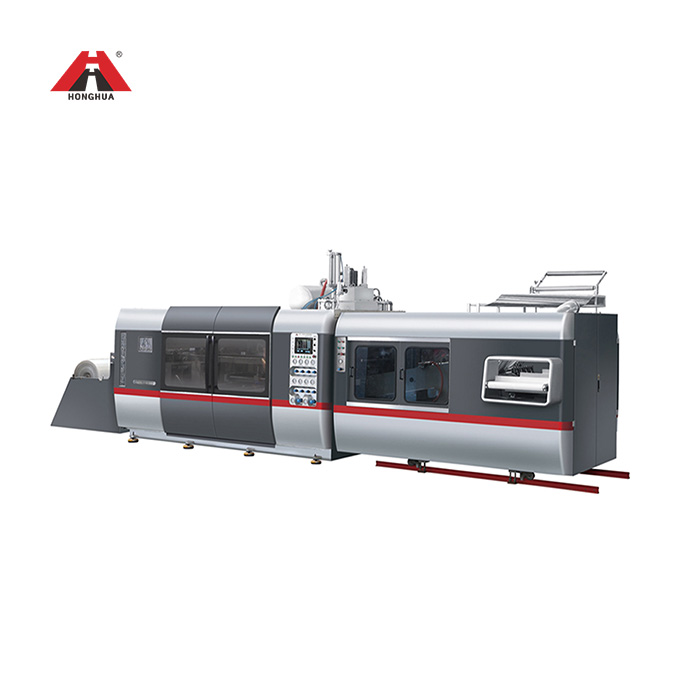
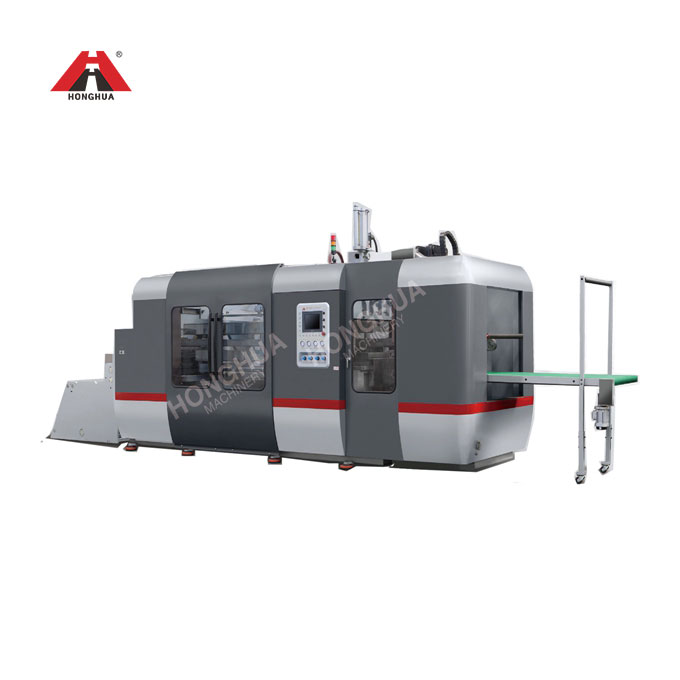
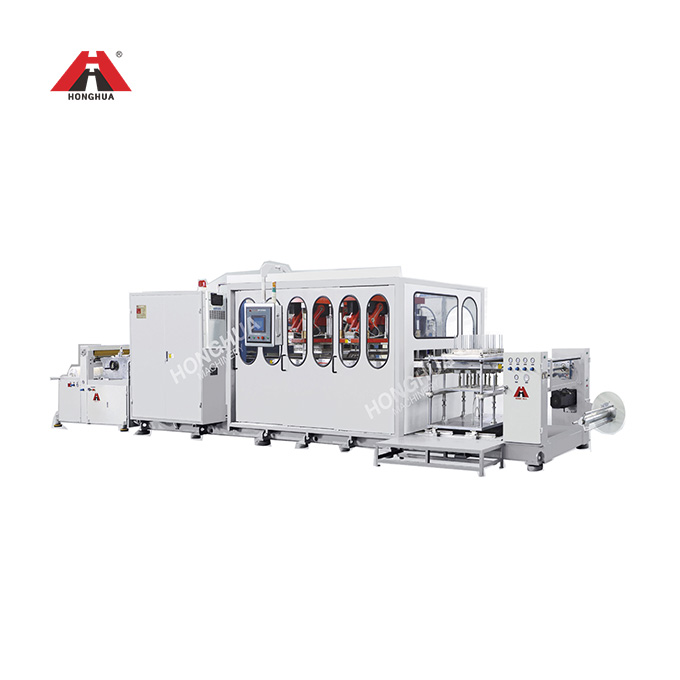
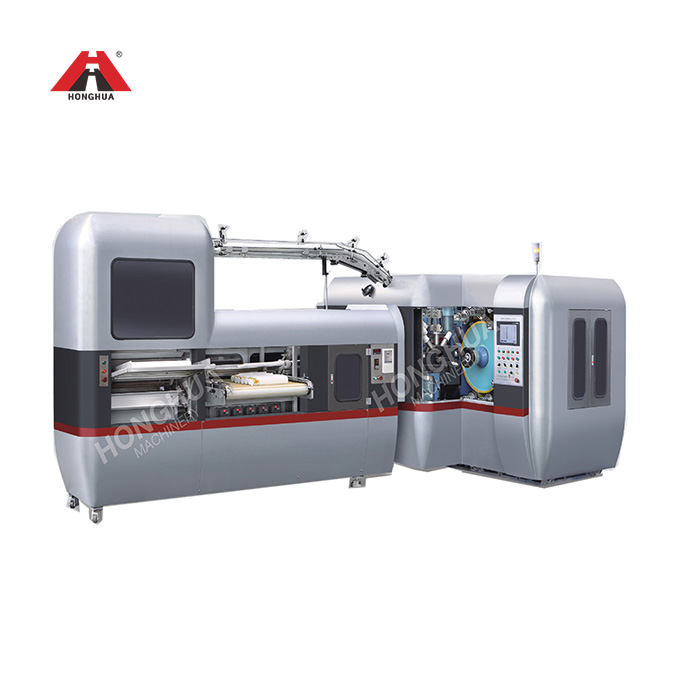
A list of important items to be considered in thingage thermoforming machinery design.Typically.roll.re,d thin.gage machinery designs are much more restrictive than those for heavy.gage.Thin..gage machines are designed to produce hundreds or thousarods of parts per hour.Unlike heavygage lk)rming. thin—gage forming appears as a continuous,.seamless operation.It is not,even though sheet is supplied to the former fr"om continuous rolls or directly fI. om an extruder,.For most roll-fed formers.the forming step iS static.req uiring the sheet to remain in contact with a stationarv mold for several secondsl.As a result,the sheet remains stationary in the oven for-1ike amount of time.Trimming of the part from the web or trim is also done while the sheet is stationary.The sheet is advanced from station to station in a jog or start-stop fashion.In certain areas.rollfed thermoforming machines are portions of more complex systems such as the cup production schematic or the form-fill-seal operation. Sheet is usually transferred from the takeoff roll through the heater.forming press and trim die by means of a pair of endless chains containing regularly spaced pins or other impaling devices.The pin-chains are usually parallel although provisions can be made to allow the chains to diverge throughout their entire path or only in certain segments.Chain divergence is considered necessary when forming poly.mers with excessive sag,such as LDPE,PP and PET.Unlike heavy. gage forming machinery,thin-gage machinery sheet width is usually restricted to less than about 52 in or 1.3 m.For crystalline polymers or polymers that show excessive sag,sheet width is restricted to leSS than about 32 in or 0.76 m. unless sag bands are used.The sheet in the pin-chain region is usually shielded from the intense radiant heat to minimize sheet pull-out.
Electric radiant heat dominates the heating methods for thin-gage sheet.For decades.metal rod and wire heaters were the common means of heating thin-gage sheet.Ceramic or quartz heaters are used in most new machines.The newer heaters offer greater flexibility in controlling the amount of heat directed to certain portions of the sheet.The absorption of energy by the sheet depends on:
·The polymer classification,such as PVC, ·The type and dosage of various adducts pigments,and ·The thickness of the polymer sheet. PE,PET or PS,in the polymer,particularly colorants,The last factor is most critical to the selection of proper equipment.As discussed in The totaI amount of energy absorbed is strongly dependent on the thickness of the polymer sheet.For very thin sheet or film.a substantial portion of incident radiant energy may be transmitted completely throu the film.As a result,thin sheet and film heat very slowly when infrared heating is used.Direct contact heat transfer is recommended for thin films of thicknesses of less than about 0.005 in or 0.1 3 mm.for thin-gage sheet where the surface has been printed or metallized.or for thin-gage sheet that is Iaminated or contains embedded energy absorbers such as carbon or metaj fibers.These aspects and others are discussed detail in Chapter 3 on heating the sheet. |