|
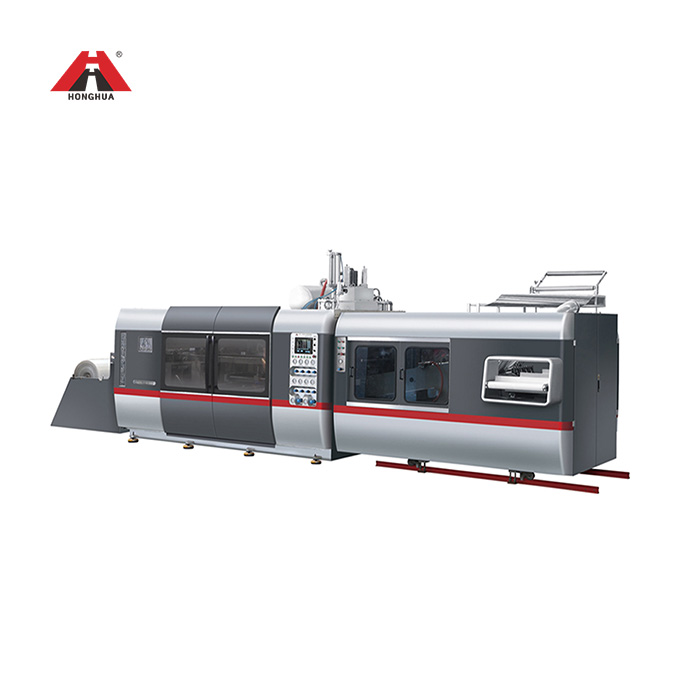
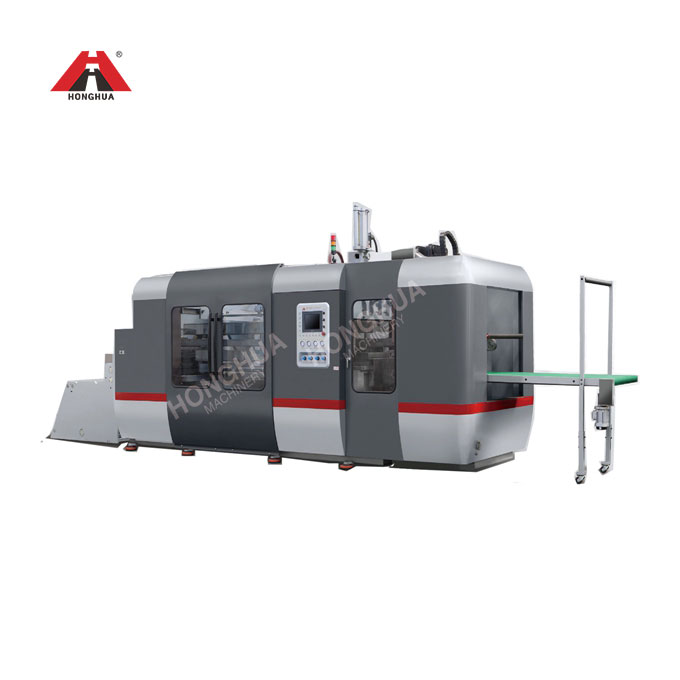
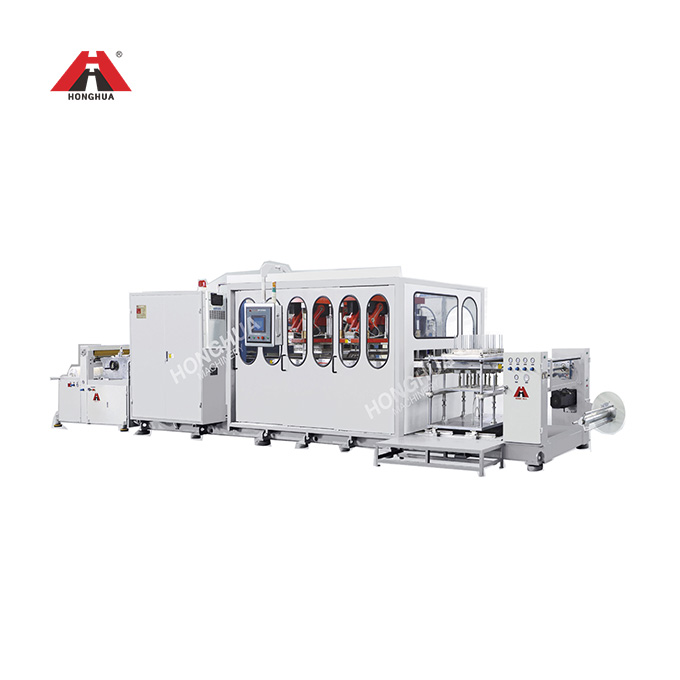
The forming station should include all elements necessary to prestretch the sheet form in, coot it and eject it form the mold. Some of these elements include:
l Substantial guide-rods are needed. For vacuum molds greater than 12 in or 300 mm by 24 in or 600 in dimension and for all pressure forming applications, four guide-rods are recommended. Cup Making Machine
l Clamp tonnage should be in proportion to mold size, that is:
Typically >1001b/in or 0.7 Mpa for straight vacuum forming, and
Typically >2001b/in or 1.4 Mpa for pressure forming.
l The press frame pit should not be deeper than 4 ft or 1.3m. In many areas, pits dee[er than this must be entered by people wearing self-contained breathing apparatus.
l The overheaded press frame structure should be robust enough to support such elements as:
The entire weight of the mold, if it is desired to mold in an “up”position,
In-mold trimming components including cylinder and framework,
Ancillary nold elements such as:
Plug assist cylinder and frames,
Ejector cylinders and frames, and
Cavity isolator cylinders and frames, and
Pressure boxes.
l The press should allow for easy mold removal and maintenance.
l The press platens should allow for easily adjustable mold daylight.
l There should be adequate headroom for overhead ancillary equipment.
l There shuould be adequate space around the presses for vacuum lines,vacuum and air pressure lines, and adequate mold tempreature hoses and mamifolds
l There should be adequate provision for prestretching and billowing, sheet lock-down and stripping and ejecting.
l There should be allowance for free surface tempreature control, including chilled air.
l There frame should be adequately reinfored and gusseted to carry heavy molds, ancillary hardware, and day-to-day vibration and shaking.
l There should be adequate provision for part removal and trim or web takeway Printing Machine
The drive system that raises and lowers the platens is the key to forming station performance. Depending on the application, the drive unit can be as inexpensive as a simple air cylinder or as complex as the hydromechancial clamps used on injection molding presses. Table 1.8[21] rates some of the drives used in thermoforming presses. Many high-speed presses use electric toggle clampps and cams. For high-speed pressure forming of polypropylence, double toggle clamps and used. Some straight hydraulic clamps are used in high pressure applications. Electrically driven clamps are being developed that are touted to be more accurate with less maintenance than conventional clamp systems. Most vacuum forming drive systems are designed to close and clamp at maximum pressures of 20 to 40 1b/in or 0.15 to 0.30 Mpa.
Table 1.8 Comparision of Forming Table Drive Units
|
Characterisitc Pneumatic Geared Hydraulic Pneymatic Ecentric Motor-driven
air motor- driven Motor-cams spindle
cylinder cogwheel toggle |
|
Uniformity 0 5 4 0 3 5
Strike limit control 5 5 3 3 5
Timing control 2 5 4 1 2 4
Repeatability 0 5 4 0 3 5
Speed control 3/4 0/2/5 5 1 0 2
Forming 3 3 5 0 1 5
Clamping force 3 3 5 5 5 4
Stability-stracking 3/4 0/3 4 4 5
Energy consumption 5 1 0 3 2
Trouble-free nature 5 0 2 4 3
Maintenance 4 5 0 2 3 3
Noise level 0 5 3 0 4 1
Construction quality 3 1 5 5 5
Cost 5/2 4/1 0 3 1 1
Preblowing capacity 5 5 0 0 0
|
|
Total 30/31 61/65 42/45 26 41 50 |
Pressure forming, the drive system must clamp against the forming air pressure. Safety factors of 3 to 4 are recommened. If 30 1b/in or 2 Mpa air pressure is used in forming, the drive system should be designed to remain closed against 90 to 120 1b/in or 6 to 8 Mpa pressure. For a typical mold forming area of 20×10 in or 500×250 mm, the drive system clamping load is 9 to 12 T or 32 to 107 Mkg.
Platens and guide-rods must be designed to accommodate high bending force. For forming pressure in excess of 100 1bf/in2 or 0.7 Mpa, forming station designs begin to resemble those used in thermoplastic structural foam injection molding [22]. For forming pressures in excess of 200 1 bf/in2 or 1.4 Mpa, the presses begin to resemble those used in compression molding. |