Two-step forming with prestretching
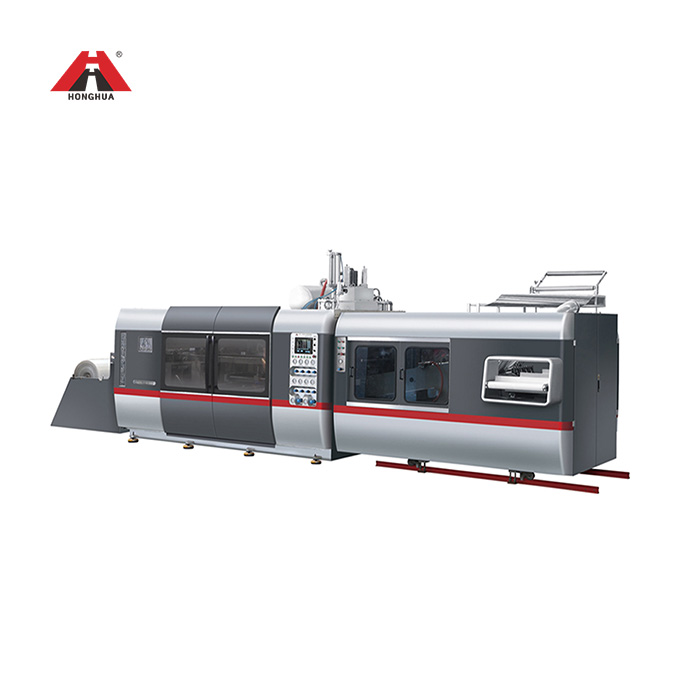
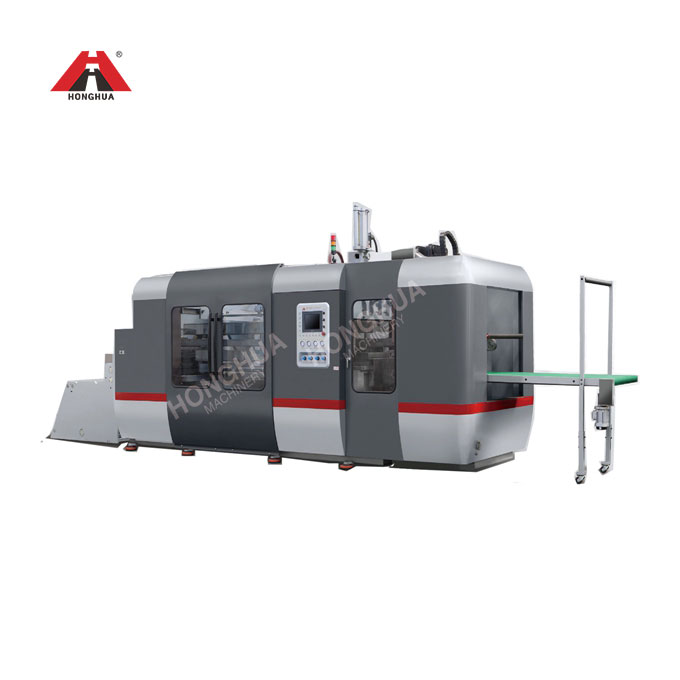
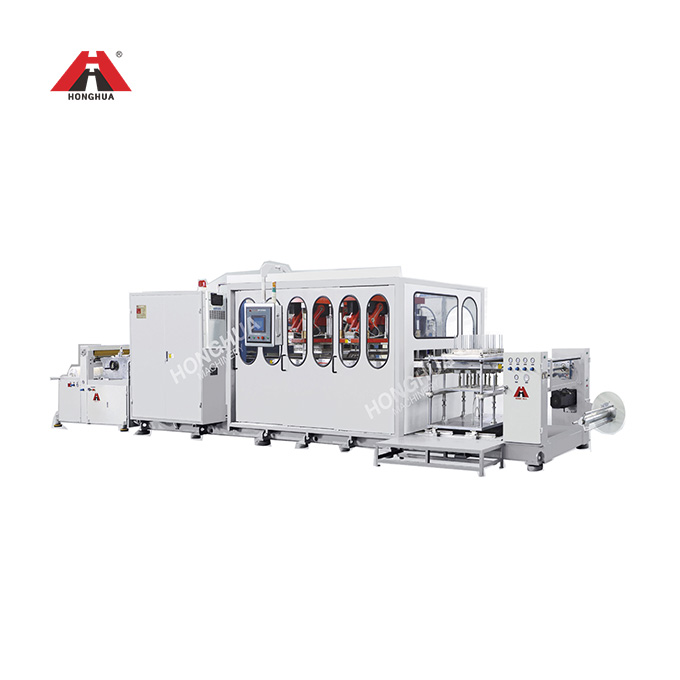
Multi-step forming was developed primarily for heavy-gage sheet where single parts are often quite complex anddeep and where cost considerations make wall thickness uniformity a significant design parameter. In thin-gage thermforming, forming thmes are very short and shapes are relatively simple. Until a few years ago, thin-gage forming was restricted to one of the one-step techiniques described above. In the 1970s, the development of plug assisted pressure forming of PP below its melting temperature led the way to highly automated muliti-step forming of thin-gage roll-fed sheet. The first step in mulit step forming is usually a form of sheet stretching, such as plug assist or billowing. The prestretched sheet is then pressed against the mold surface. Some examples of multi-step forming follow: Thermoforming Machine
l There are many variations of bubble or billow prestretching. The first step is to pneumatically inflate the clamped heated rubbery sheet to a controlled height with internal air pressure. Typically the differential pressure is 0.014 to 0.055Mpa or 2 to 8 1 b f/in 2 gauge. The bubble height is controlled either by touching a microswitch or by intercepting a photoelectric eye.A this point ,the mold can interact with the stretched sheet in one of serveral ways: Cup Making Machine
l In billow drape forming, the male mold is pressed into the top of the prestretched sheet. This techniqueyields a part with wall thicknesses that are much more uniform than that obtained with straight drape forming.
l When a femle mold is used, in billow ucacuum forming , the differentched pressure that has inflated the bubble is reversed.This causes the prestretched sheet to snap into the female mold. Again, the part wall thickness is much more uniform than that obtained with conventioal vacuum forming. The eversion of the bubble can be tricky.So this technique is difficult.
l If vacuum is used to pull the bubble, a vacuum box is needed . The male mold is immersed or plunged into the prestretched bubble and the vacuum released and air pressure applied. The bubble then snaps against the mold. The technique is called uacuum snap-back forming.The billow drape forming and the vacuum snap-
back methods work well as pressure forming technique as well.
l The heated rubbery sheet can also be stretched with a mechanically driven plug. There are several plug assisted methods: Printing Machine
l The most common form of plug-assisted thermoforming is plug assisted vacuum forming with a female mold.The sheet is prestretched by pressing the plug into it and forcing the sheet toward the bottom of the femmale mold cavity.Vacuum is then applied to pull the sheet aggainst the mold surface.
l If the sheet is forced against the female mold surface with air pressure applied through the plug, the technique is know as plug assist pressure forming.
l Plug-assisted drape forming onto a male mold is used when the draped sheet must be tucked into three-dimensional corners or into an undercut. It is also used to stretch pladtic sheet away form a male portion of a female mold to minimize webbing. Extrusion Line |