Other Variations
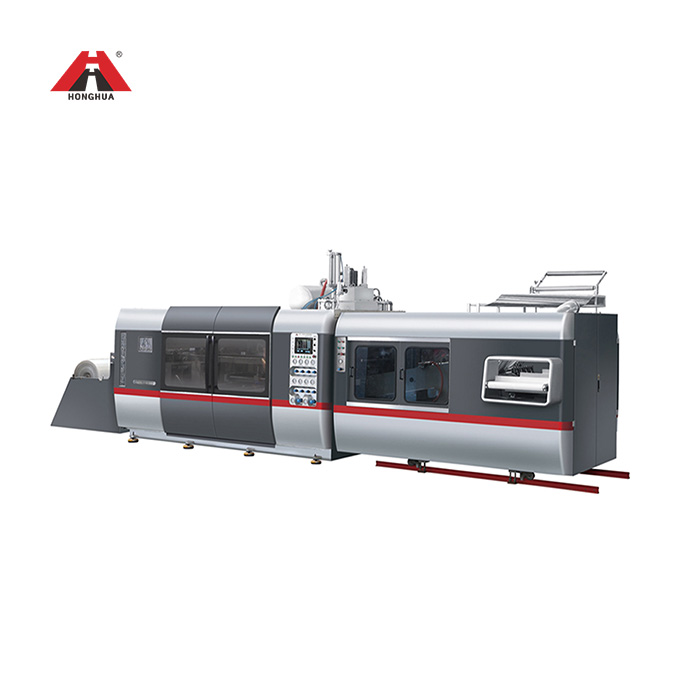
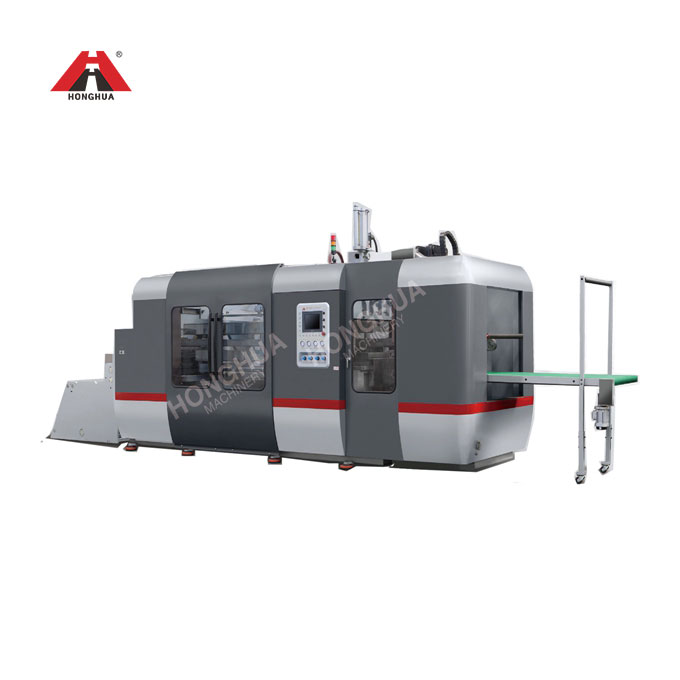
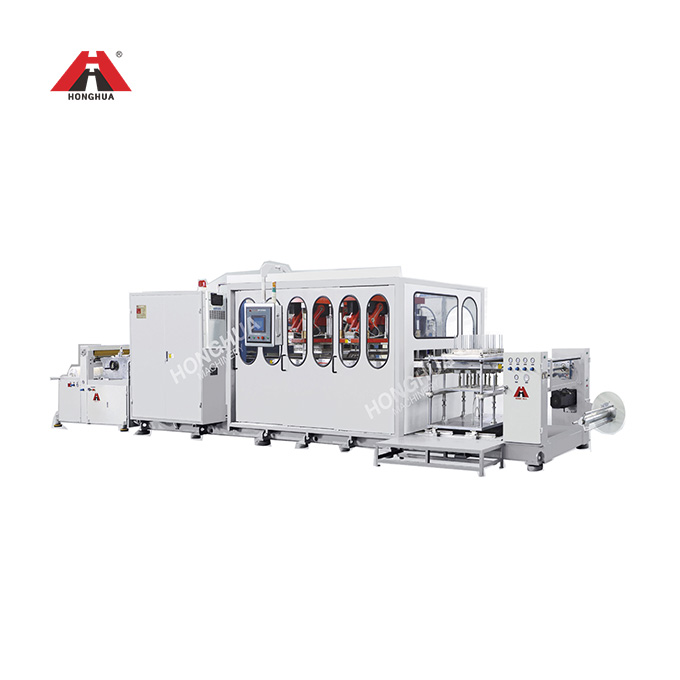
In order to form certain types of polymers, technique other than those discussed above have been devised: Thermoforming Machine
l Trapped sheet forming is used when:
The polymer is thermally sensitive, such as certain types of PVC,
The polymer is excessively saggy, as with PP and certain types of LDPE and LLDPE,
The poylmer sheet is highly oriented, as with oriented PS and PP,
The sheet is flocked or metallized on one side,
The sheet is laminated with a temperature-sensitive adhesive,
The sheet contains wires or printed circuits that are temperature-sensitive,
The sheet is very thin and printed or embossed on one side,or
The sheet is less than about 0.005 in or 0.13 mm.
The clamped sheet is held against a heated plate until the polymer reaches its forming temperature. Pressure is then applied through holes drilled in the plate, forcing the sheet away form the plate and against the female mold. Aleternately, vacuum is applied, sucking the sheet away form the heater and against the mold. The plates are heated with electric rod heaters. Although drilled plate is usually used, there os growing interest in porous bronze or stainless steel plates. Zonal or pattern heating is possible by using insulating plate sections that are heated to different temperatures. Cup Making Machine
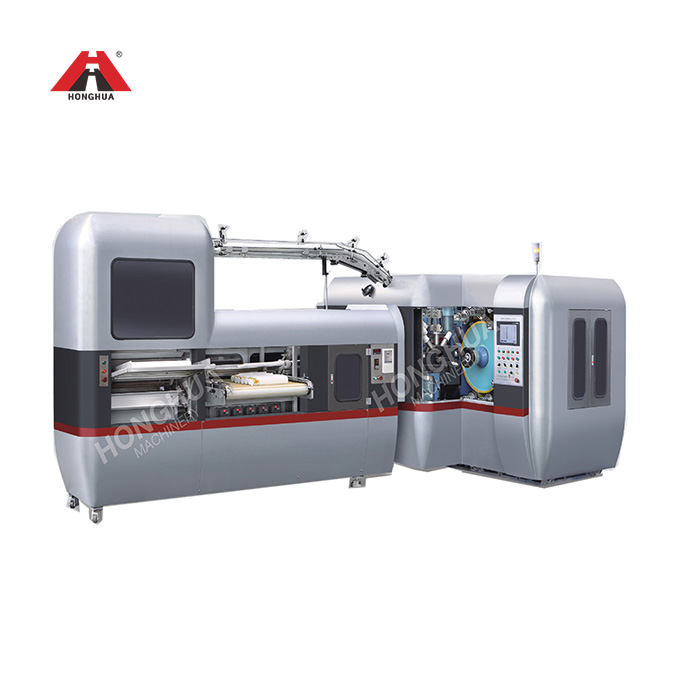
l In slip forming the heated rubbery sheet is not tightly clamped. As the differential pressure is applied, instead of the sheet being stretched, it is drawn form the clamp. Over the mold rim and into the cavity. At a predetermind time, the sliding is stopped by increasing the clamp force. This is done by compressing springs as shown ,or by using cam-type rockers that squeeze against the sheet after a predetermined amount of rotation. Slip forming parallers deep-draw metal forming practice. It is used to form continuous-fiber reinforced polymer composite sheet.. Printing Machine
l Splitty plastics such as PET and PA or nylon and certain multiayer structures are best formed without splitting using diaphragm forming. A warmed thick walled neoprene bladder or diaphragm is placed against the clamed heated rubbery plastic sheet. The bladder is inflated with air or with a liquid such as hydraulic fluid or hot water. The inflating bladder stretches the plastic sheet into a female mold. Very uniform wall thicknesses and relatively deep draws are obtained for plastics that cannot be formed in other ways.
l Twin-sheet thermoforming has been a technically viable process for many years. There are several variationgs on this process.One approach is called simultaneous twin-sheet forming. Two sheets are keptseparate whlie heating, then brought together in a doulbe female mold arrange-ment. Blow pins are inserted between the sheets. Air inflation begins as the sheets are clamped toghter and the mold halves close. The air pressure keeps the sheets from initially touching and then provides the force meeded to press the sheets form initially touching and then provides the force needed to press the sheets against the mold surfaces. Automatic cup stacker
Twin-sheet forming produces a relatively flat hollow part that with proper design of kiss-offs and pinch-offs is light weight and very strong. The hollow cavity can also be filled with PUR foam for additional stiffiness and insulation. For large , heavy-gage parts, the technique competes with biow molding and rotational molding.
In roll-fed thermoforming, twin-sheet forming is used in a different way. Packages that provide oxygen and moisture barrier are sought. The most effective barrier materials such as PAN, EVOH and PVDC are usually quite expensive and so are used as thin films between layers of less expensive but durable polymers such as PP, HDPE,PET and PS. The results are usually laminates of essentially incompatible plastics glued toghter with poly-mers such as EVA that behave as hot-melt adhesives. The web and trim form coextruded laminates of some of these polymers cannot be reprocessed successfully without degradation and gel formation. As a result, a ariation on the tmin-sheet thermoforming process was developed wherein separate sheets of the candidate polymers are fed firm individual rolls, through sandwich heater and then brought toghter right at the forming station. Once the multi-layer trim are brought has been trimmed, the individual layers in the web and trim are stripped form one another. Each polymer web is therefore “clean”and is recycled to produce new sheet. The diverse layers of material in the formed product are only contact-adhered and so will delaminate through misuse.
If the force applied to the sheet increases, thermoforming begins to mimic metal forming techniques. A t pressures of 1.73Mpa or 250 1bf/in2, the process is similar to tin metal embossing. At pressures of 6.9 Mpa or 1000 1 bf/in2, the process resembles coining. At pressures of 13.8 Mpa or 2000 1 bf/in2, the process is like compression molding or forging[20]. It has been adequately demonstrated in the Dow scrapless thermoforming or STP process,that useful products can be in the Dow scrapless thermoforming or STP process, that useful products can be fabricated with high-speed impact forming. The incentive to achieve more uniform part wall thickness even in very draw parts continues to spur development of these mulit-step procedures. The more sophisticated procedures become, the more difficult it is to adapt them to high-speed forming without exacting process controls.And yet many new packaging applications for example ,are seeking just such designa. Thermooforming process innovation remains a lively art. |